Bambu Lab A1
A low-cost cartesian FDM printer
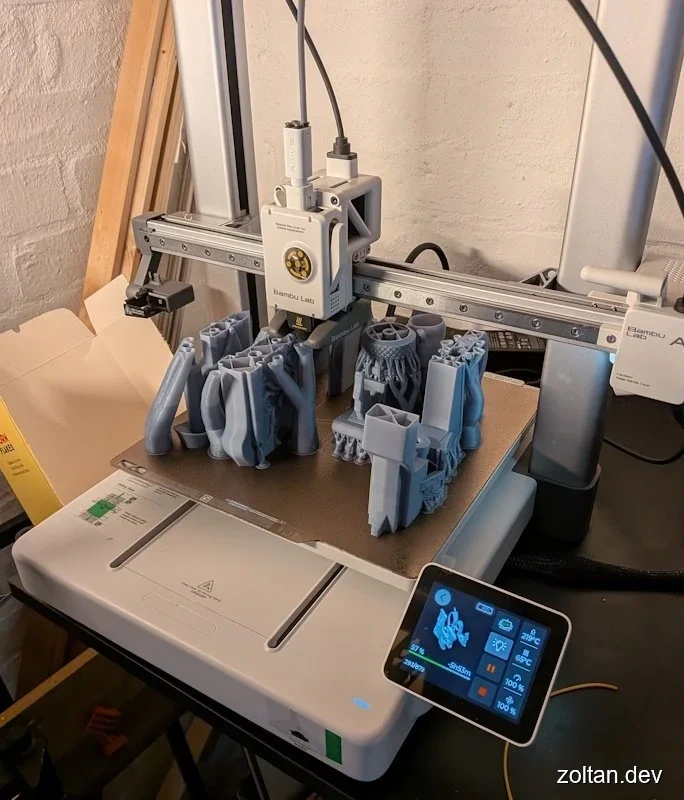
Most projects in this portfolio were printed on a Bambu Lab A1. It is a popular Fused Deposition Modelling printer that takes spools of extruded thermoplastic and lays them layer by layer on a heated surface. This printer was chosen for many reasons:
FDM over SLA
The printing material used by the A1 is solid and harmless to hold, making it much more user-friendly than Stereolithography (SLA) printing that requires toxic chemicals and a lengthy post-processing step. While the precision and quality of an SLA print is far beyond what is capable with an FDM printer, the convenience and safety of an FDM printer were the deciding factors.
Cartesian over Cartesian Cube/CoreXY
Cartesian printers usually use 3 stepper motors that control 1 axis each. The X stepper moves the print head left and right, the Z stepper moves the print head up and down, and the Y stepper moves the print bed forward and backwards. Cartesian Cube printers (like the Creality Sermoon V1used until the Bambu Lab A1 was purchased) move the print head in both the X and the Y direction, only moving the print bed up and down (along the Z). CoreXY printers like the Bambu Lab X1C use a combination of 2 stepper motors to position the print head, moving heavy components from the gantry to the printer itself, allowing much higher movement speeds.
There are generally several disadvantages of Cartesian printers over Cube/CoreXY printers, namely:
- Slowerprint speeds.
- High risk of shaking parts off the print bed during Y-axis movements.
- More space is needed during printingbehind and in front of a cartesian printer due to the movement of the print bed.
There is however one big advantage that cartesian printers have over CoreXY printers:
- They are very cheap.
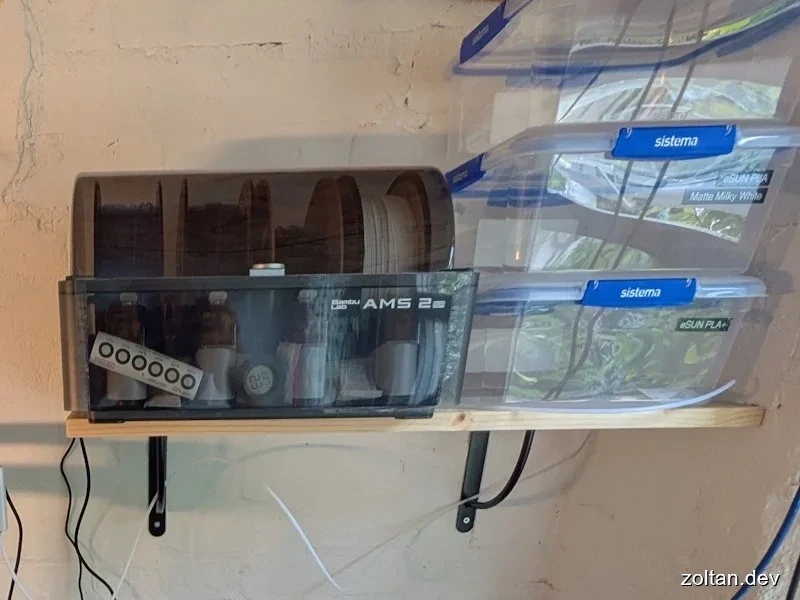
The workshop environment in South Wales presents persistent humidity and cold temperatures. This adversely affects 3D printing filament, as moisture seeps into the plastic, causing printing issues. Filament can even snap during prints, causing failed prints and even necessitating disassembly of printers or AMS units in order to clear the debris.
A Bambu Lab AMS 2 Pro is used to heat the filament in order to reduce the humidity in the sealed filament container, to automatically feed the Bambu Lab A1 with up to 4 different filament spools without needing human intervention, and to keep moisture out of filament when it is dried. For long-term storage, Sistema 5.5L containers are used and filled with large amounts of silica gel in order to keep the filament clean and in good condition.
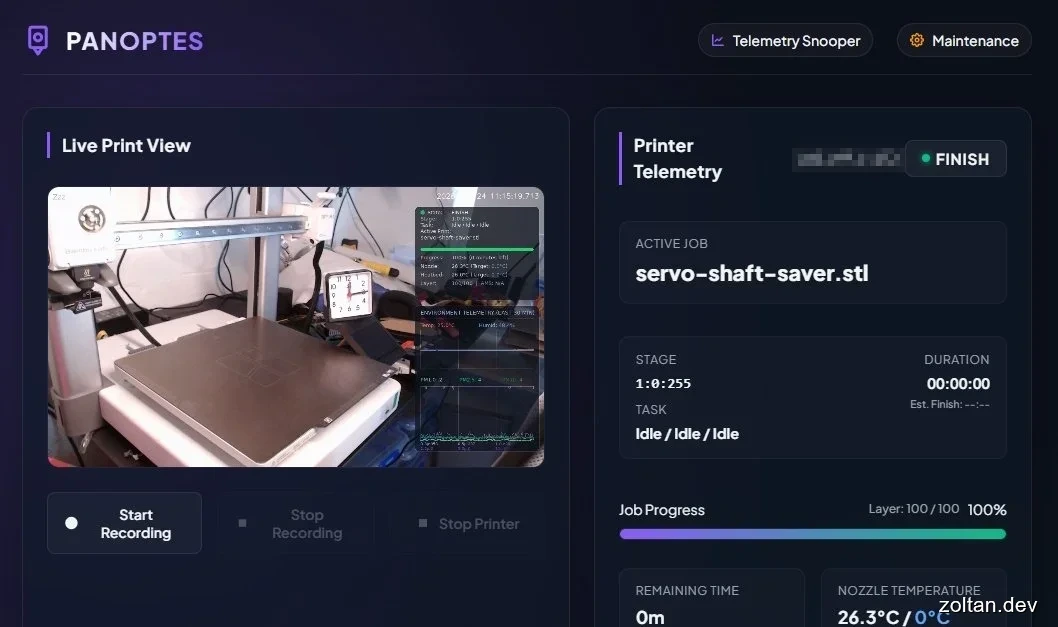
For monitoring the printer, the 3D monitoring system Panoptes was developed—a 3D printer monitor, timelapse recorder and environment sensor suite that notifies via SMS alerts and push notes on other devices as soon as prints are finished, if prints get stuck for any reason, or if the climate in the workshop becomes too cold, hot, humid or polluted to work in.